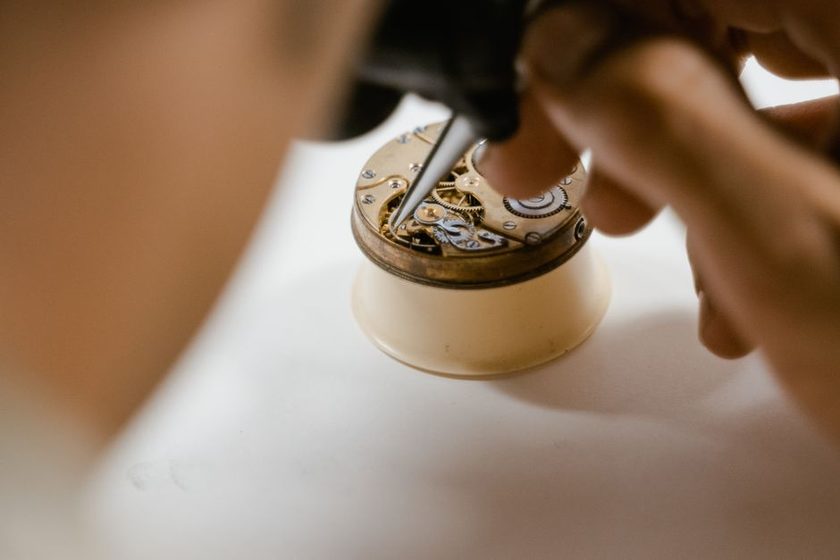
A 1963 service sheet for a workhorse manual-wind caliber lists three oils by name: a light one for the balance and escapement, a medium one for the going train, a heavy one for the barrel and keyless works. All three stopped being made decades ago. The chart isn't wrong — it was accurate the day someone typed it, for a product that hasn't existed in any bottle since before most people reading this were born. What sits on the bench today is a real movement with real pivots and real jewels, and the actual job is matching a viscosity class that was never incorrect to an oil that no longer exists to buy.
What a Service Sheet's Number Actually Meant
Watch oil catalogs from that era graded products the way a kitchen recipe grades flour — light, medium, heavy — but the words described specific formulations, not abstract physics. A "light" oil in 1963 might have been a refined natural oil or an early synthetic, chosen because it spread thin and stayed low-drag on a fast-moving balance staff. A "heavy" oil was chosen for the opposite reason: it resisted migration under the slow, high-torque grind of a mainspring barrel. The manufacturer knew exactly how each formulation aged, how it thickened or dried, and roughly how long it held its properties before needing replacement. That knowledge left the catalog when the product did. A technician reading the same three words today has the class name and none of the chemistry behind it.
Pivot Size Is the Variable That Didn't Change
What hasn't changed is the geometry. A balance staff pivot on a mid-century movement is still somewhere around a tenth of a millimeter across; a center wheel pivot is still several times that. Pivot diameter and the clearance inside its jewel bore are physical facts, not brand facts, and they're the load-bearing part of the decision. A thin oil in a bore built for a fat pivot pumps out under load. A viscous oil packed into a fine pivot's bore adds drag that shows up as a measurable amplitude loss on the timegrapher trace before it shows up anywhere else. Estimating pivot size from the wheel it belongs to — balance, escape, third, center, barrel arbor — gives a far more reliable starting point than trying to reverse-engineer what a discontinued product number once meant.
Jewel Type Changes the Requirement, Not Just the Pivot
A capped jewel and an open, through-hole jewel ask for different behavior from the same nominal viscosity class. On a capped setting, the oil has to stay centered against a flat surface under a convex pivot tip, held there mostly by surface tension rather than by the bore geometry that keeps oil still in an open jewel. Choose an oil with the wrong spreading behavior for a capped jewel1 and it creeps to the edge and off the jewel entirely within weeks, long before any charted viscosity number would predict trouble. This is where a 1960s number stops being useful even as a rough guide — the old catalogs bundled spreading behavior and viscosity into one named product. Modern synthetic lines separate the two properties, so the substitution has to reason about both: viscosity for the pivot, spreading for the jewel, instead of matching one label to another.
1Epilame treatment is a chemical coating applied to a jewel's surface so oil stays confined to the oil sink instead of spreading across the whole jewel face. A pivot re-oiled without matching the original epilame treatment can migrate even when the viscosity class is correct.
The number on the service sheet was never wrong. It described a product precisely, on the day someone printed it. It has just been describing something that stopped existing for longer than most of these watches have been running.
Reasoning Through a Substitution
A working method looks less like a lookup table and more like a short interrogation, repeated for each oiling point on the movement:
- What wheel does this pivot belong to, and roughly how large is it?
- Is the jewel capped or open, and how worn is the cap-jewel setting?
- What's the movement's beat rate — a faster train tolerates less drag before amplitude drops?
- Was the original formulation likely to have hardened or thinned with age, and does that change what's actually sitting in the bore now versus what the sheet assumed?
None of those questions has a printed answer. They're read off the movement itself — pivot wear under a loupe, the width of the jewel's oil sink, the behavior of the balance once it's running. That's also why the case for re-oiling on a schedule holds even when a movement is still keeping reasonable time: an oil chosen well for one pivot at service time still ages on its own clock, independent of whatever number got it there.
| Old chart language | What it actually describes | Typical pivot | What a modern substitute has to match |
|---|---|---|---|
| Light / fine oil | Low viscosity, fast to spread, minimal drag | Balance staff, escape wheel | Low drag at high beat rate, not just a low number on a chart |
| Medium oil | Balanced viscosity for a moderate load | Third and fourth wheel | Stays put across the going train's speed range |
| Heavy oil | High viscosity, resists migration under torque | Barrel arbor, keyless works | Resists gumming and hardening under slow, sustained load |
| Cap-jewel oil | Formulated around surface tension, not viscosity alone | Balance cap jewels | Spreading behavior matched to the cap-jewel geometry |
Why This Stays Judgment, Not a Lookup Table
None of this means the printed numbers are useless. They still say something true about relative viscosity — light was lighter than medium, medium lighter than heavy, in whatever units that catalog used. What they can't do anymore is point at a shelf product. A technician working from a modern synthetic line has to translate a relative ranking from a discontinued system into an absolute choice from a current one, using pivot size and jewel type as the reference points that survived the decades between them. Two technicians can reason through the same movement, land on adjacent oils in a current range, and both be defensible — the decision was never going to reduce to one correct answer, only to a band of reasonable ones bounded by the physics of the pivot actually in front of them.
This is a field note on how a hobbyist bench reasons through a servicing decision — it describes a way of thinking about oil selection, not a specific recommendation for any particular watch. A movement with real value, or any doubt about what's inside it, is a job for a trained watchmaker with the reference material and stock on hand.