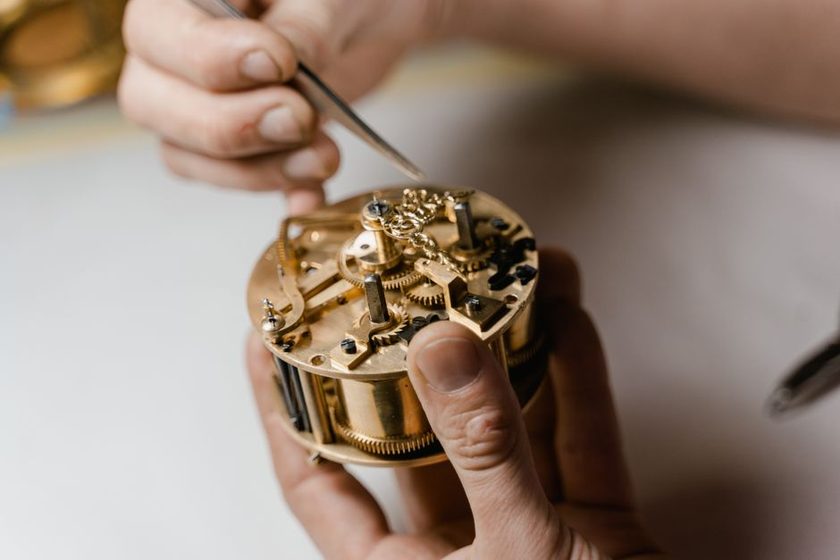
A watch that gains eight seconds a day is not broken. It's telling you something, and rarely is that something the regulator's fault. I've watched a lot of people — myself included, twenty years ago — reach straight for that little index arm the moment a rate drifts, and nudge it like a volume knob. It isn't one. The regulator never touches the balance wheel, the jewel, or the escapement. It touches two brass pins, and those pins touch the hairspring, and that's the entire mechanism. Knowing what happens between them is the difference between a five-minute correction and an afternoon chasing a rate that keeps sliding away.
The Two Pins, and What They Actually Touch
On a pin-lever regulator, the hairspring's outer coil runs between a pair of curb pins mounted on an arm that pivots over the balance cock. The spring is pinned to the stud at one end and to the balance staff at the other; everything between those two fixed points is free to flex on every swing. The pins don't grip the spring — in a correctly adjusted watch there should be a whisper of clearance, not a clamp. What they do is mark a boundary. Past the pins, toward the stud, the coil is effectively locked out of the motion. Only the length between the staff and the pins does the work of pulling the wheel back on each beat.
Slide the arm toward "F" and the pins move closer to the stud, shortening that working length. A shorter spring is stiffer for its size, so it snaps the balance back quicker and the watch ticks faster. Slide toward "S" and the working length grows, the spring relaxes, and the rate slows. No gears, no springs within springs — just a moving boundary on a coil that's already doing its job.
Why a Millimeter Feels Like an Hour
The rate of a balance-spring system scales with the square root of stiffness, and stiffness is roughly proportional to the inverse cube of working length near the terminal curve. That relationship is not gentle. Near the end of the coil, where the pins usually sit on a vintage caliber, a move small enough to be invisible can swing the daily rate by ten or fifteen seconds. A well-mapped movement might carry twenty index divisions across its dial, each representing four to twelve seconds a day depending on the caliber. That's why a "small tap" on an unfamiliar movement is a gamble — you don't know how many seconds live inside a millimeter until you've measured it.
A regulator pin doesn't nudge the rate. It renegotiates where the spring is allowed to bend — and the spring answers with a rate change out of all proportion to how far you moved it.
The Overcorrection Habit
The most common mistake I see on a home bench isn't touching the regulator — it's touching it twice in the same sitting. You move the index toward "S," check the rate on a timegrapher, see it's still fast, and move it again. Now it's slow, so back it goes. Each pass adds friction between coil and pins, and risks pinching the terminal curve out of plane. A spring walked back and forth a dozen times in an afternoon often shows worse positional variance afterward — not because the rate is wrong, but because the coil no longer breathes symmetrically.
The fix is sequence, not patience alone: one move, a full 24 hours in a fixed position, then read the result before touching anything again. A rate still drifting after a single correction is usually asking you to look somewhere else.
If a movement gains fast right after a full wind and settles closer to true by the second day, that's not a regulator problem at all — it's isochronism, and no amount of index-arm work will touch it. Regulator corrections only make sense once the rate is stable across the wind, not chasing a curve that's already correcting itself.
Reading the Symptom Before Touching Anything
A regulator only changes effective spring length, so it can only fix an error that's genuinely uniform — the same fast or slow reading dial-up, dial-down, and in the positions you actually wear the watch. If the error only shows up in one position, or right after winding, the pins are the wrong tool. Low amplitude from a tired mainspring or thickened oil produces its own symptoms that look, at a glance, like a simple fast or slow watch — nudging the index just layers a second error on the first.
| Symptom | Likely cause | Regulator fixes it? |
|---|---|---|
| Same rate off in every position | Effective spring length slightly off | Yes |
| Fast for a day, then settles | Isochronism / mainspring torque curve | No |
| Fast dial-up, slow crown-down | Positional error, poise or pivot friction | No |
| Amplitude under ~200° dial-up | Dried lubricant, weak mainspring, dirt | No |
| Tick and tock uneven on the trace | Beat error, hairspring not centered on the stud | No |
What Actually Changes When the Pins Move
Beyond working length, a few things shift together whenever the arm travels:
- The pinning point of "free" coil moves along the terminal curve, which can change how symmetrically the spring breathes if that curve isn't shaped evenly.
- Contact friction between coil and pins changes with clearance — too tight and the spring drags with every beat; too loose and the pins do nothing until the swing is large.
- On some calibers the regulator arm also carries the stud holder, so a large move can shift where the spring is anchored, not just how much coil is exposed.
None of this is a reason to avoid the regulator — it's a century-old mechanism that works exactly as designed. It's a reason to move it once, measure, and treat every later pass as a separate decision. Logging the before-and-after rate is what turns a guess into a repeatable correction — it's also most of what a beat error check is doing in the background.
Free-Sprung Balances: Sidestepping the Mechanism Entirely
Higher-grade movements often drop the curb pins altogether. A free-sprung balance has no arm touching the hairspring — the outer coil is fixed, and rate is adjusted instead by moving small weighted screws around the rim of the balance wheel, changing its moment of inertia rather than the spring's working length. The hairspring breathes unobstructed on every beat, removing the friction and pinning-point variability curb pins introduce by nature. The tradeoff is practical: adjusting one takes a proper timing machine and steady hands on tiny screws, not a quick twist of a lever — a bench job for someone experienced, not a kitchen-table five-minute fix.
This piece describes how a curb-pin regulator works mechanically — it's a mechanism explainer, not a repair guide. Hairsprings distort permanently under careless handling, and a movement showing mixed symptoms usually needs a full diagnostic before anything gets touched, not a single fix guessed from one number.
Read also
Why a Watch Runs Fast After a Full Wind
Isochronism failure is not a fault of your watch alone — it is a property of the balance spring under changing torque.

Positional Error and Why It Isn't a Flaw
A movement that gains in dial-up and loses in crown-down is behaving exactly as gravity and geometry predict.
Reading a Mainspring's Set
A spring that has taken a permanent set behaves differently at the bench than one fresh from the barrel — here's how to tell.