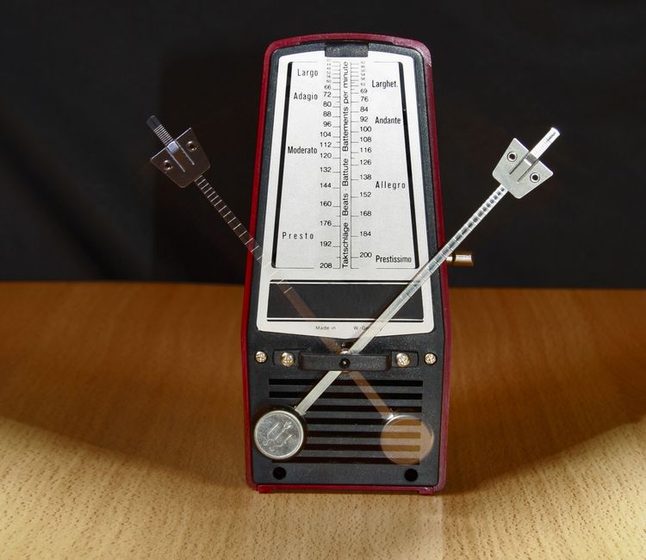
The watch on the kitchen table this evening is a manual-wind piece from the early 1960s, freshly serviced and recased, and by rights it should sound like a tiny, patient pendulum clock under a loupe — one steady tick-tock, evenly spaced. It doesn't, quite. Set a kitchen metronome next to it and the difference is obvious inside ten seconds: the metronome's tick and tock land exactly halfway apart, and the watch's don't. One side of its beat arrives a hair early, the other lags to make up for it. That small unevenness has a name — beat error — and a metronome is one of the easiest ways to hear it before you put a number on it.
Beat error — the difference, in milliseconds, between the time the balance takes to swing one direction through center and the time it takes to swing back. Not the same thing as rate.
What the Two Sounds Are Actually Telling You
Every time the balance wheel swings through center, the impulse pin catches the pallet fork and the escapement gives it a small shove — one on the swing left, one on the right. Those two shoves are the tick and the tock. In a perfectly adjusted movement, the balance sits exactly centered at rest, so both swings take precisely the same time, and the tick-to-tock gap equals the tock-to-tick gap. Beat error is simply the difference between those two gaps. It has no bearing on how fast or slow the watch runs overall — a watch can gain eight seconds a day with beat error near zero, or keep perfect average time while carrying three milliseconds of asymmetry.
Set the Metronome, Then Listen
This is the exercise that made beat error click for me long before a timegrapher ever sat on the bench. Set a metronome to somewhere around 60 to 80 beats a minute and let it settle into its rhythm for a few seconds. Then rest the watch, dial up, on the same table, close enough that both sounds reach you together.
- Start the metronome and let it settle for several beats before listening to anything else.
- Lay the watch flat, case back down, a few inches away.
- Close your eyes and follow only the watch's tick-tock for thirty seconds.
- Ask whether the gap feels even, the way the metronome's does, or whether one side rushes.
Most people expect this to be subtle. It usually isn't. A watch carrying two or three milliseconds of beat error produces a tick-tock that sounds almost like a limp — not arrhythmic, just lopsided. For what the same balance wheel's swing looks like once you graduate from ear to trace, see Reading Amplitude on a Timegrapher.
A metronome only has to keep one interval steady. A balance wheel has to keep two — and prove, twice every beat, that they're equal.
Putting a Number on the Asymmetry
Ears are a fine screening tool, but a timegrapher turns the impression into a measurement. It listens to the same two clicks through a contact microphone on the case back and reports the gap between them directly in milliseconds. A watch beating at 21,600 vibrations per hour completes one full beat — tick to tick — in roughly 166 milliseconds; beat error asks how that interval splits into its two halves. Zero would mean an exact 83/83 split. A 2.0ms reading means closer to 84/82 — small enough to slip past a stopwatch, large enough for a trained ear on a metronome test.
What Counts as Acceptable
There's no single number that separates fine from needs-attention — tolerance depends on the caliber and its age. A modern movement built to a tighter spec is often adjusted under half a millisecond at the factory. A well-worn 1960s piece that has never been touched can sit at two or three milliseconds and still keep respectable average time, because the two unequal halves of its beat stay consistent from swing to swing.
| Reading | What it tends to indicate |
|---|---|
| Under 0.5ms | A tight bench or factory adjustment; common target after a full service |
| 0.5–1.5ms | Normal range for most vintage movements once serviced |
| 1.5–3.0ms | Audible on a metronome test; common on unadjusted pieces |
| Over 3.0ms | May reduce amplitude in vertical positions; often worth correcting |
Read those ranges as tendencies, not a diagnosis. The same figure can mean something different on a robust field-watch caliber than it does on a delicate dress-watch movement with a fine hairspring.
The Hairspring Stud Fixes This — Not the Regulator
The instinct, the first time beat error shows up on a trace, is to reach for the regulator — it's the lever everyone associates with adjusting a watch. It's the wrong tool here. The regulator pins change the effective length of the hairspring as it breathes, and that changes how fast the balance oscillates — rate, not beat. Moving them can nudge a watch from five seconds slow to three fast a day, but it does nothing to even out an asymmetric tick-tock, since it never touches where the balance sits at rest. The fuller version of that distinction is in What the Regulator Pins Actually Do.
Beat error lives at the hairspring stud instead. The stud anchors the outer end of the spring to the balance cock, and its rotational position sets where the balance's rest point falls relative to the pallet fork's own rest position. Loosen the stud carrier, rotate it a small amount, tighten it back down, and remeasure — the two halves converge without the overall rate shifting more than a second or two, since the spring's working length never changed, only its starting angle. It's a patient adjustment: a fraction of a degree, a fresh reading, another fraction — the way a mainspring's set, covered in Reading a Mainspring's Set, tells its story slowly too.
This entry describes the mechanism at work, not a walkthrough. Correcting beat error means removing the balance cock and working directly on the hairspring stud, which is easy to damage without the right tools and practice.
What stays with me is the metronome comparison itself, more than any number on a screen. A metronome's whole job is to keep one interval honest, forever. A balance wheel is asked to keep two, and to keep proving — tick, tock, tick, tock — that they're the same length. Most of the time it manages. When it doesn't, you can hear it before you can prove it, at a kitchen table with a cheap metronome and a watch older than you are.