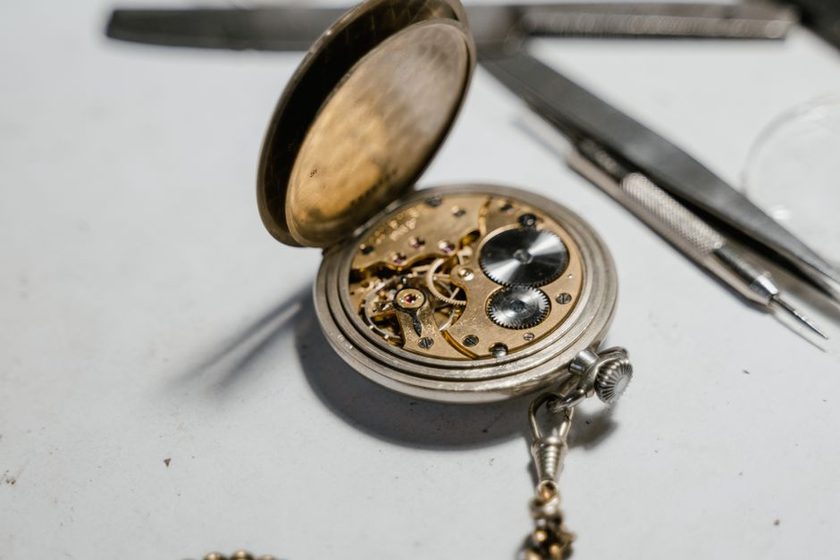
A watch that has run since the 1960s doesn't go dry the way a car runs out of oil. It slows down first, in increments too small to notice from one wind to the next, and by the time a timegrapher trace makes the problem undeniable, the movement has usually been running lean for a year or more already. The lubricant hasn't disappeared from the jewel. Open the barrel bridge on a piece that's overdue for service and you'll almost always find oil still present — thickened, pushed to one side of the cap jewel, a fraction of a millimeter from where the pivot needs it. The five-year figure in most service manuals has surprisingly little to do with the oil running out. It has everything to do with what a few microliters of lubricant do to themselves, quietly, while nobody is watching.
The oil rarely leaves — it moves
Every pivot jewel on a freshly serviced movement gets a deliberate, tiny reservoir of oil, held in place partly by the jewel's own cupped geometry and partly by epilame — a molecular coating applied to the metal around the jewel specifically so the oil can't creep past its border. Epilame is the reason a well-oiled pivot stays wet at the point of contact instead of spreading itself thin across the plate. It's also the first thing to give out. The coating degrades under the same conditions that stress the oil itself — heat, motion, ordinary atmospheric oxygen — and once it fails, capillary action does exactly what capillary action always does: it pulls the oil toward whatever surface offers it the most contact.
A jewel that looked perfectly serviced at month one can show a visibly dry pivot and a faint oil ring on the surrounding plate at month forty, without a single drop having evaporated anywhere. The lubricant is a few tenths of a millimeter away from where it's needed, and at that scale, a few tenths of a millimeter is the entire distance between a healthy bearing and dry metal turning on metal.
Viscosity is a moving target, not a fixed quantity
Even oil that stays exactly where it was placed doesn't stay the same oil. Watch lubricants are formulated to a specific viscosity for a specific job — a thin, fast oil for the balance pivots, something heavier for the barrel arbor, a grease with real body for the mainspring's coils. Every one of those formulations starts reacting with atmospheric oxygen the moment it's exposed to air, and that reaction only moves one direction: toward thicker, gummier oil. Oxidation products build up inside the film gradually, raising its resistance to shear long before the volume of oil itself shrinks in any meaningful way. A balance pivot swinging through several beats a second doesn't care whether oil is technically still present. It cares whether that oil is thin enough to let the pivot turn freely — and a film oxidized to twice its original viscosity is, for practical purposes, most of the way to being no lubricant at all.
An oxidized oil film doesn't fail all at once. It fails the way a habit does — a little worse every week, until the day someone finally asks why the trace won't sit still.
What sixty years of formulation actually changed
It helps to split this by era, because the interval has a history behind it. Movements from the 1950s and 60s were serviced on natural oils, often refined from animal sources, prized for the low-friction properties that made them useful and for the instability that made them a recurring problem. Natural oils oxidize fast; a two- or three-year interval on those calibers wasn't caution so much as arithmetic. See Choosing an Oil for a 1960s Movement for what that means at the bench today, since the original oils these calibers were designed around are long out of production. Modern synthetic esters were engineered specifically to slow that oxidation curve, and that slower curve is the entire reason five years has become the default rather than the older three-year one. Slower isn't the same as absent, though. A synthetic oil still oxidizes — it simply takes longer to reach the viscosity where a bench can measure the difference.
| Oil generation | Typical service interval | What changes first | Migration risk |
|---|---|---|---|
| Natural, pre-1970s calibers | 2–3 years | Fast oxidation and gumming | High — period epilame degrades quickly under heat |
| Early synthetic esters | 3–4 years | Gradual viscosity increase | Moderate |
| Modern synthetic esters | 4–5 years | Slow oxidation; stays mobile longer | Lower, but not zero |
| Barrel-grade synthetic greases | 4–6 years | Thickens under sustained torque | Low — formulated to resist creep |
| Pallet-stone lubricant | Tied to full service | Loses damping property before it visibly thickens | High if the epilame border fails first |
What the five-year number is actually buying. The interval isn't a countdown to an empty jewel. It's a rough estimate of how long a given oil formulation tends to stay within its working viscosity range before oxidation and migration push it out — and that range shifts with how a watch is worn, wound, and stored, not with a fixed clock.
What a starving film looks like on the trace
A worn pivot and a dry pivot can both produce poor amplitude, and it's tempting to read the two the same way. They don't behave the same on a timegrapher, though, if you watch more than one run. Genuine mechanical wear — an out-of-round pivot hole, a bent balance staff — tends to produce a low reading that's at least consistent: run the same position twice and the depressed amplitude repeats closely, because the geometry causing the loss hasn't changed. A lubrication problem behaves differently. Read Reading Amplitude on a Timegrapher for how to separate that pattern from ordinary positional variance. Watch the same dial-up trace twice, thirty seconds apart, and a starving pivot will often show a real swing between the two runs — 240° on one pass, 205° on the next, nothing else changed — because the film's resistance to shear is itself changing as it gets dragged around. Under a loupe at the escapement, the tell is sticking: the balance settles into its swing and then hesitates, almost imperceptibly, at the same point in the arc each time, rather than swinging through clean.
- Run the amplitude trace twice in the same position, thirty seconds apart — a swing of 20° or more between runs points to lubrication, not geometry.
- Look for a faint oil ring on the plate around a jewel that itself looks dry — the classic sign of epilame failure and migration.
- Watch the escapement under magnification for a stutter or catch at the same point in every beat, which suggests a dragging film rather than a bent pivot.
- Weigh the last service date against the movement's oil generation, not just a flat five-year rule applied without context.
Telling lubrication from wear before reaching for a screwdriver
None of this means every erratic trace is a lubrication problem, and sticking alone shouldn't be treated as proof — a bent hairspring or a magnetized balance can produce their own kind of instability, and a careful bench rules those out first, with a demagnetizer and a close look at the spring's coils, before touching the mainspring or the pivots. What a tired oil film has going for it, diagnostically, is that it rarely stays subtle once you know the pattern to look for: instability that worsens the longer a run continues, that varies between otherwise identical runs, and that improves noticeably once the movement comes back from a clean and a fresh oiling. A worn part doesn't improve with cleaning. A tired oil film does.
This article describes general lubrication behavior in mechanical watch movements for educational purposes. It isn't a substitute for inspection by a qualified watchmaker, and any service interval should be weighed against the specific caliber, its oil history, and how the watch is actually worn — not applied as a fixed rule on its own.